Gugan Gulwan Youth Aboriginal Corporation acknowledges the Traditional Custodians of the lands on which we walk, work, live and learn. We honour Elders past and present and extend our respect to all Aboriginal and Torres Strait Islander peoples who now call this region home. We recognise the strength, wisdom and care they bring to community, and the vital role they play in supporting our young people and families to grow strong, connected and thriving together.
THE ABORIGINAL AND TORRES STRAIT ISLANDER CHILD PLACEMENT PRINCIPLE
The Aboriginal and Torres Strait Islander Child Placement Principle has been shaped by Aboriginal and Torres Strait Islander leaders and community-controlled child welfare organisations, emerging from grassroots advocacy in the 1970s in response to the profound harms caused by child removal policies, including those that led to the Stolen Generations, and was formally recognised in Australian child welfare legislation in the early 1980s.
The Aboriginal and Torres Strait Islander Child Placement Principle affirms that culture, family, community and Country are fundamental to the safety, wellbeing and identity of Aboriginal and Torres Strait Islander children. It recognises that Aboriginal and Torres Strait Islander families, communities and community-controlled organisations are best placed to make decisions about children’s care and protection and must be actively involved in every decision affecting their lives.
Across all Australian jurisdictions, the Aboriginal and Torres Strait Islander Child Placement Principle is embedded in legislation, policy and practice and is foundational to building a culturally safe national child protection system that uphold the rights of Aboriginal and Torres Strait Islander children, families and communities.
The Aboriginal and Torres Strait Islander Child Placement Principle aims to:
— embed culture as central to the safety and wellbeing of Aboriginal and Torres Strait Islander children,
— uphold the rights of Aboriginal and Torres Strait Islander children, families and communities in contact with child welfare systems,
— strengthen self-determination for Aboriginal and Torres Strait Islander people in child protection decision-making,
— reduce the over-representation of Aboriginal and Torres Strait Islander children in out-of-home care and the broader child protection system,
— support family-led decision-making, prevent unnecessary entry into care and promote family reunification where separation occurs.
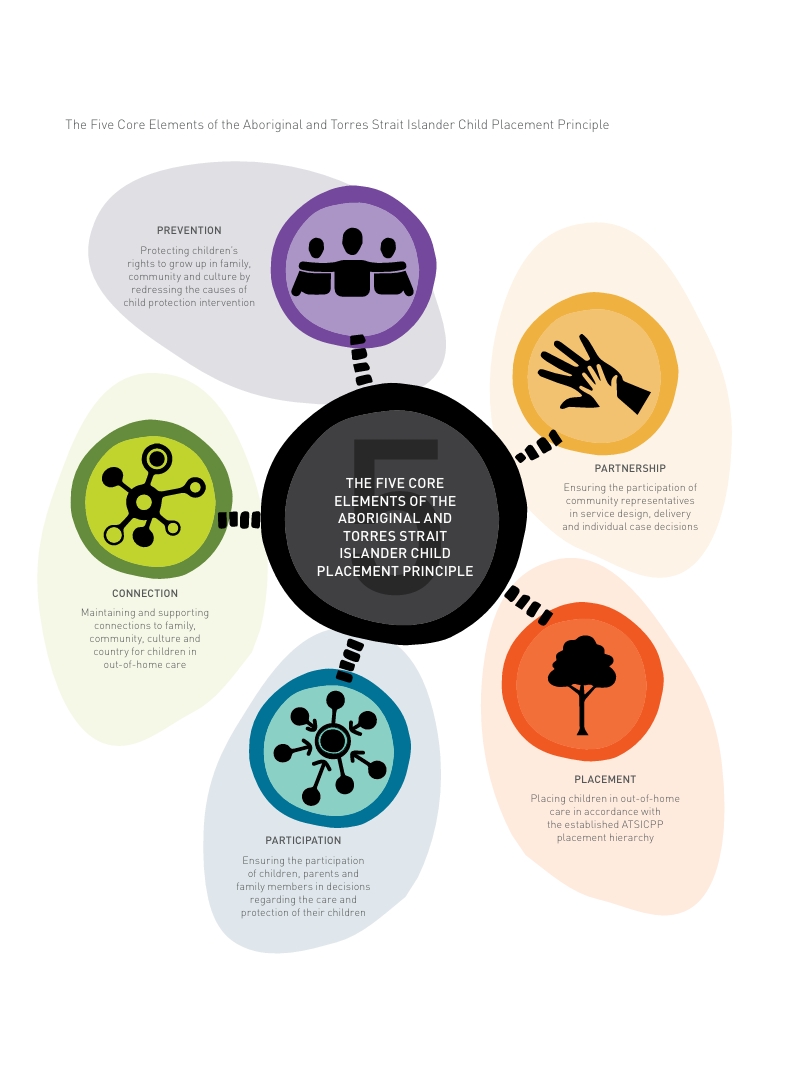
The Child Placement Principle comprises five interrelated elements; Prevention, Partnership, Placement, Participation and Connection, which must be applied together to realise the full intent of the Principle.
By centering prevention, cultural connection, community leadership and self-determination, the Child Placement Principle supports stronger connections for children and families and contributes to reducing over-representation of Aboriginal and Torres Strait Islander children in child protection systems.
The Aboriginal and Torres Strait Islander Child Placement Principle has been enacted within the policy and legislation of every Australian state and territory to some degree.
The Aboriginal and Torres Strait Islander Child Placement Principle is founded upon the assertion that the removal of an Aboriginal and or Torres Strait Islander child from their family should be the last option and that the reunification of children to their families be of high priority.
The Aboriginal and Torres Strait Islander Child Placement Principle has been enacted within the policy and legislation of every Australian state and territory to some degree.
The Aboriginal and Torres Strait Islander Child Placement Principle is founded upon the assertion that the removal of an Aboriginal and or Torres Strait Islander child from their family should be the last option and that the reunification of children to their families be of high priority.

